Rating: 5,5|Votes: 8
‘Why don’t you settle down somewhere in one place on a permanent basis?’ ‘If I do, who will guide the Orthodox faithful on all these islands?’ he replied forcefully and with great bitterness. ‘Just think, how much suffering there is there! Five islands and the southern American republics, and there is not a single Orthodox priest!
Fr. Thomas Hopko
Rating: 10|Votes: 1
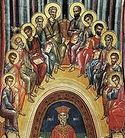
Tradition says that to fulfil the prophecy of Joel, the Holy Spirit descended not only on the twelve chosen Apostles, but also upon all those who were with them "with one accord in one place", that is, on the whole Church. This is why in Icons of Pentecost there are represented Apostles not belonging to the twelve - Apostle Paul, and among the seventy, Luke the Evangelist and Mark the Evangelist.
The day of Pentecost was the day, when the Old Testament theocracy which began on Sinai and ruled the people through the written law, the law of slavery and of death, was replaced by the New Testament law, where the people are led by the Spirit of God, the spirit of adoption and freedom (Rom. 8). Thus, as the Pascha of Christ abolished the Old Testament Pascha, the New Testament Pentecost replaces the Old Testament one, from which life under the law began.
The tenth day following the Ascension of our Lord Jesus Christ was the fiftieth day following Christ’s Resurrection. Following the Lord’s direct instruction, all of the Apostles, the Mother of God, other disciples of Christ, and other faithful were together, of one accord, in Jerusalem. It was the third hour of the day – in our terms, 9:00 AM. Suddenly there was a sound from the Heavens, like unto a mighty rushing wind, filling the entire house in which Christ’s disciples were. Then, tongues of fire appeared and came to rest upon, i.e. as it were became established upon, each of them, a single tongue of fire upon each.
Old Russian monasticism was a clear manifestation of the morality of Russian secular society: the yearning for departure from the secular world was growing along with the rise of moral standards and not because of increasing calamities. It means that Russian monasticism was renouncing the world for the sake of ideals too high for it, and not for the sake of principles hostile to it. —V. Klyuchevsky